 NearWord
Divinity: Original Sin 2 — reading ability descriptions
Dialogue asks you to read between the lines. Combat asks you to read the fine print. Don’t miss the words that change a decision.
Follow the narrator’s meaning
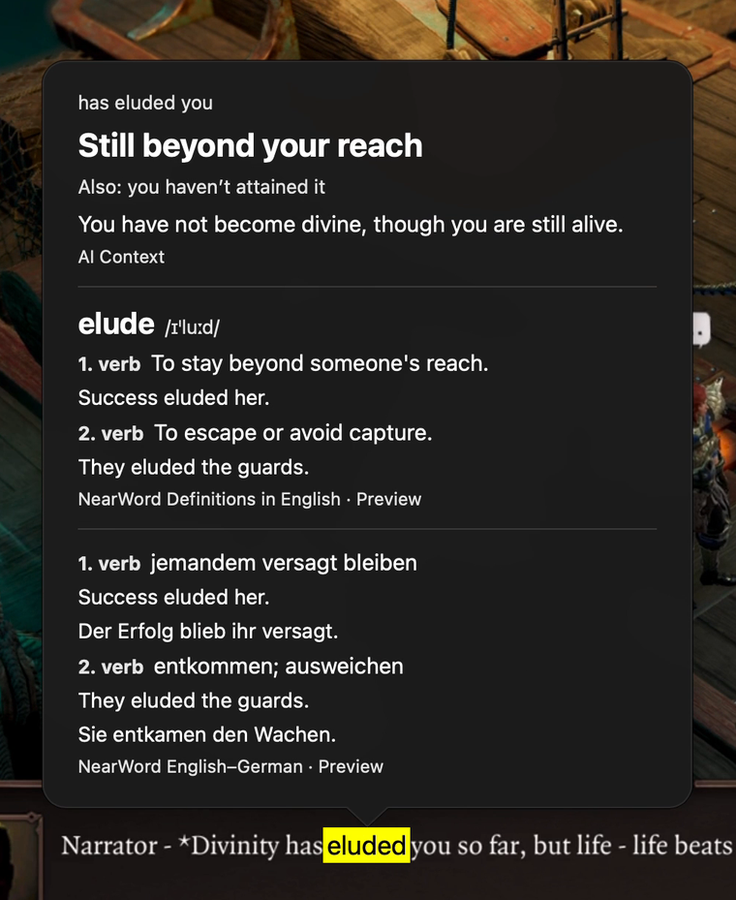
A familiar sentence can hinge on one unfamiliar verb. In the scene below, the narrator says that divinity “has eluded you so far.” Checking eluded makes the line clearer without translating the whole conversation.
Out of reach, not running away
Eluded comes from elude. Here, divinity has remained out of your reach. The same verb can describe escaping pursuers; the examples show the difference. The English definition sits alongside a translation and a short explanation of this line.
From items to conversations
The dictionary helps with short names and labels. If a longer reply or journal entry leaves you unsure, try a context explanation, then read the original again.
Read an ability in three passes
First find the action: what happens? Then find the target: to whom? Finally, check the condition and duration: when does it apply, and for how long? This is a reading method, not a recommendation about which ability to use. NearWord is most useful at the exact word that prevents one of those answers.
Keep ordinary vocabulary separate from named statuses. A dictionary can explain a verb, but a status with a similar name may have a specific effect defined by the game. After looking up the wording, return to the tooltip and any linked descriptions before making your move.
Collect words along the way
Repeated expressions become easier to remember when you meet them in familiar situations. NearWord history lets you return to them after the game.
Try NearWord
Available on macOS. Downloaded dictionaries work offline without an account. AI Context is optional and needs an account and internet access.
Download NearWord